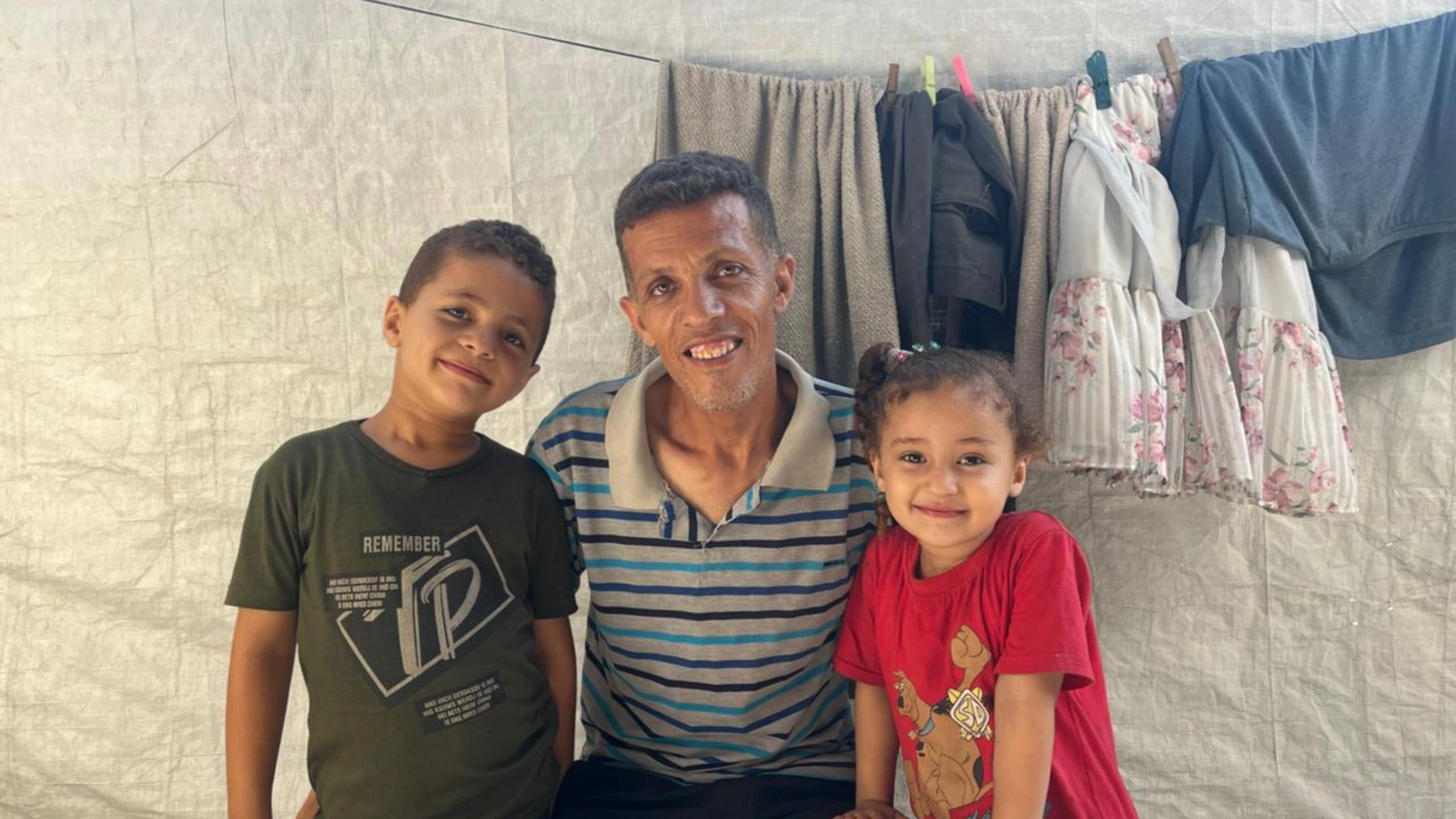
Help Sameh and his family survive and heal
 This campaign has not yet completed extended verification
In the name of the highest degrees of humanity, I speak to you from Gaza.
Each day that passes is worse than the one before.
I speak to you with the heart of a human being who is on the brink of death and collapse.
Every day, we witness death—and wait for it. But for every soul, there is a destined time.
Here we are, waiting for God’s relief.
Maybe death will take me, or maybe we will continue to battle the burdens and hardship of life.
I am Sameh Hamad, from the heart of the Gaza Strip, from the city of Beit Hanoun.
I graduated from the Faculty of Sociology in 2013 and worked in my field at several institutions.
I was happy in my work, although most of it consisted of short-term training sessions.
Still, I struggled deeply with the lack of job opportunities in Gaza.
I am married and built a beautiful family. I have two children: Mahdi, my 7-year-old son, and Tia, my 4-year-old daughter.
My wife graduated from the Faculty of Education.
Due to the scarcity of work in our land, I began helping my father in his tailoring profession, and I would earn my living from that shop.
Eventually, I opened my own store to support my family, which cost me $10,000 to establish.
My wife worked at a private educational center to help me meet our family’s needs.
We were an extremely happy family, living in a modest home we had built with love—surrounded by my parents, my family, my neighbors, and my friends.
Then came this brutal and painful war, which took away the people dearest to us.
They destroyed my home and reduced it to ashes.
My workplace was turned into dust—as if it had never existed.
And with it, our dreams ended—my children’s dreams, which I had always tried to nurture, support, and fulfill.
We were left without shelter, without food, without water, without clothing—without anything that makes life livable.
I lost my identity, and all I have left are my tears and heartbreak.
I had worked so hard to build everything.
I also lost loved ones dear to me: three uncles—whom we count as martyrs, my grandfather and grandmother, my brother’s wife, my wife’s grandfather and her uncle.
We were once a complete family—now I sit in front of empty chairs, as they have left us forever.
Then began our displacement—from the north to the south.
I took my family to Deir al-Balah, where the bombing was everywhere.
My children lived in constant fear, watching people die right in front of them.
Terrifying images were burned into their minds—how could I ever erase them?
They now need psychological support.
One day, I took my son Mahdi with me to a barber shop to get his hair cut. Next to the shop was a mosque—which was completely bombed while we were there.
By some miracle, we survived.
But from that day, my son began to scream uncontrollably.
He broke down emotionally.
He became afraid of any outing with me.
He didn’t want to leave the house.
He started expressing himself with aggression.
His thoughts, his behavior—everything changed out of fear.
We had been displaced just as winter was beginning.
Life became even more difficult.
I couldn’t provide warm clothing for my children or even hot water to bathe them.
I resorted to buying used clothing, collecting plastic sheets, nylon, and some firewood just to provide them with basic food, water, and warmth.
Even going to the toilet became a terrifying challenge, due to the risk of disease spreading among displaced people.
We lived, in short, a life not even fit for animals—no shelter, no food, no clothes, no water, and no security.
Eventually, we returned to our city—only to find our home reduced to a pile of rubble.
It was completely destroyed.
Despite everything we endured, we tried to survive—we built a tent out of wooden scraps and tarps.
My wife and I worked together to keep our children alive.
We gathered rocks to try and block the rain from flooding our shelter.
Again, winter came, and my children cried bitterly from the freezing cold.
My daughter Tia always had a warm body—but in that tent, her heart nearly stopped from the cold.
She would cry to me and her mother:
“I’m freezing, please warm me!”
My son Mahdi also suffered severely from the cold. His tiny limbs could never get warm.
We lacked enough blankets, and yet we woke up and fell asleep every day to the sound of Israeli gunfire.
My children were terrified.
One day during Ramadan, the bombing intensified around us.
We fled again—this time to Gaza City, once again with no shelter.
What can I do?
I had returned to zero, once again.
I couldn’t even bring clothes for my children—no food, no supplies, nothing.
What can I do?
We are exhausted.
I’ve lost my will to live.
I sincerely hope that compassionate hearts will hear me.
We deserve a better life than this one.
Please help me, my children, and my wife.
Thank you, from the bottom of my heart, for reading my story.
I place all my hope in your hands—to help me and my children heal, especially from the psychological trauma they now suffer, right at the beginning of their educational journey—a journey they’ve been cruelly deprived of.
Please help us.
— Sameh